Interior experts share how to use rule of three in bedroom
Interior experts say that there’s a simple trick to creating a bedroom that’s both stylish and restful, and it all comes down to the ‘rule of three’.
What is the rule of three? It’s an interior designer’s secret weapon when it comes to creating a beautifully put-together space, and if you’re currently pondering bedroom ideas, it’s a design hack you’ll most definitely want to embrace.

(Image credit: Dominic Blackmore)
Why use the ‘rule of three’ in the bedroom?
‘The rule of three is a timeless design principle that’s rooted in human psychology and the principles that make the natural world so visually appealing,’ explains Eloise Pfeiffer, interior designer at Pfeiffer Design. ‘In a bedroom, the rule of three can work beautifully to create calm and cohesion.’
After all, nature is rarely perfectly symmetrical, so our brain tends to feel more relaxed in environments that aren’t too regimented and uniform, and relaxation is exactly what we want to achieve in the bedroom.
‘This design principle encourages grouping elements in threes to create balance and harmony within a space,’ agrees Helen Ashmore, head of design at Laura Ashley. And a space that feels balanced and harmonious is more likely to induce feelings of relaxation in our nervous system.
‘Odd numbers, especially three, feel more natural and pleasing to the eye, which is why they’re often preferred over even groupings,’ says Helen. ‘When it comes to creating a bedroom that looks beautiful yet remains a calm and restful retreat, the rule of three can make all the difference.’

(Image credit: Future PLC)
How to use ‘rule of three’ in bedroom
So now we know why the rule of three can be such a useful tool for helping the brain to relax, but how exactly would we apply it in the bedroom?
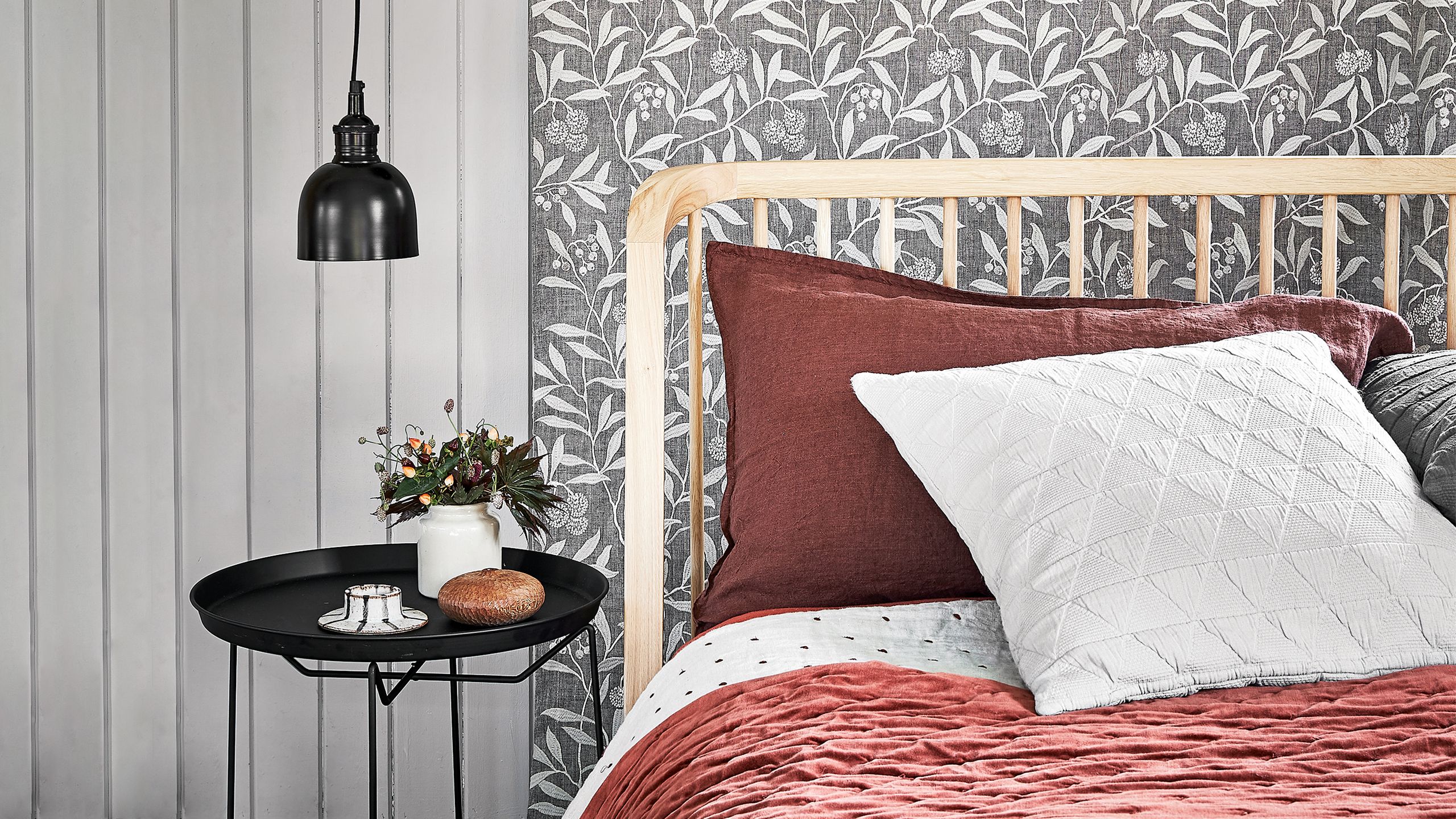
‘For styling and accessories, you would use the rule of three when dressing up bedside tables, dressers, or shelves,’ explains Emma, ‘grouping three items of varying height or texture to create a visually balanced and eye-catching vignette.’
‘Curating objects and trinkets in groups of three adds richness and draws the eye to vignettes on dressers, bedside tables, or shelving,’ agrees Helen.
So that might be a bedside table styled with a bedside lamp, a vase of flowers or a pot plant, and a trinket box for jewellery, as the image below shows.

(Image credit: Future PLC/Dominic Blackmore)
‘The rule of three also works beautifully when layering decorative pillows on a bed,’ says Helen. ‘Three pillows feel welcoming and cosy, making the space more inviting than the formality of a four-pillow, symmetrical arrangement.’
Many interior designers also bring the 3-5-7 interior design rule into the bedroom, especially when it comes to pillows! This is a way to add a few extra soft furnishings whilst sticking to the idea that odd numbers are more attractive to our brains.
For example, you might add five or seven pillows and cushions to the bed rather than limiting yourself to just three.

(Image credit: Future PLC/Chris Snook)
‘The rule of three is also particularly helpful when planning lighting,’ shares Eloise. ‘A combination of bedside lamps, wall lights, and an overhead fitting can layer the space perfectly.’
You can (and should) also apply the rule of three in more subtle ways. For instance, ‘you might repeat a colour or texture three times across the room,’ suggests Eloise.
‘In terms of applying the rule of three to colour, you would use the rule to break down three shades within the overall design scheme, says Emma. This can also be known as the 60-30-10 rule.
‘For instance, you’d have your dominant colour at 60% of the space (forming the foundation of your palette on walls, large furniture or bedding), a secondary colour at 30% (a complementary colour supporting the main shade, used on curtains, rugs or upholstery) and an accent colour at 10% (being a more bold tone used sparingly through cushions, throws, lamps or artwork).’

John Lewis
Mohair Effect Plain Throw
When picking an accent tone – such as this soft teal blue – look to repeat it three times in the room. You might choose a throw, like this mohair-effect option from John Lewis…

Habitat x Morris & Co.
Strawberry Thief Blue Ceramic Lamp
… and then pick out the same colour with a bedside lamp, such as this Habitat x Morris & Co. collaboration…

West Elm
Classic Cotton Velvet Cushion Cover
… then add a third pop of the same colour somewhere else in the room, such as using soft teal cushions on the bed or on an armchair within the bedroom.
‘The rule is also great for introducing texture and pattern,’ says Emma, ‘especially if you’re not confident with using these. By layering three textures or three different, but complementary prints, you can add depth, drama, and richness to a space whilst still keeping the overall look harmonious.’
‘If you’re someone that’s not so confident with using print, pattern and colour, then the rule of three can be a great tool to help,’ agrees Helen. ‘A great way to start is by introducing a hero print, perhaps on wallpaper or bedding, then coordinating it with a plain or striped design across other surfaces.’
‘The key is subtle repetition and variation, so the room feels harmonious and intentionally styled, without being overly coordinated,’ says Eloise.
‘As with any rules, they are meant to be broken,’ says Emma, ‘but the rule of three is a great design framework that can help to create a really beautiful, balanced and harmonious design scheme.’
link